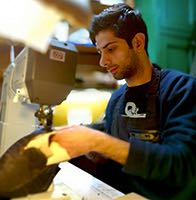
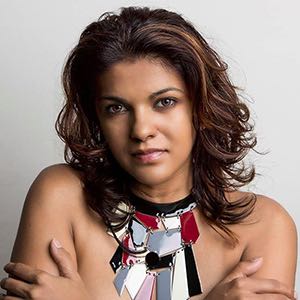
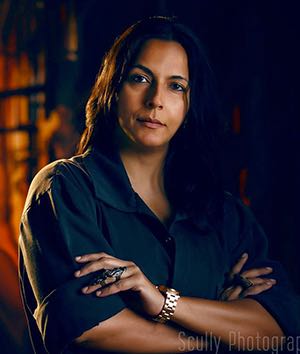
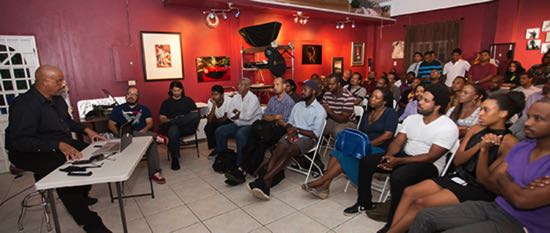
On behalf of Andrea and Alva...
06/04/13 23:42 Filed in: Talks
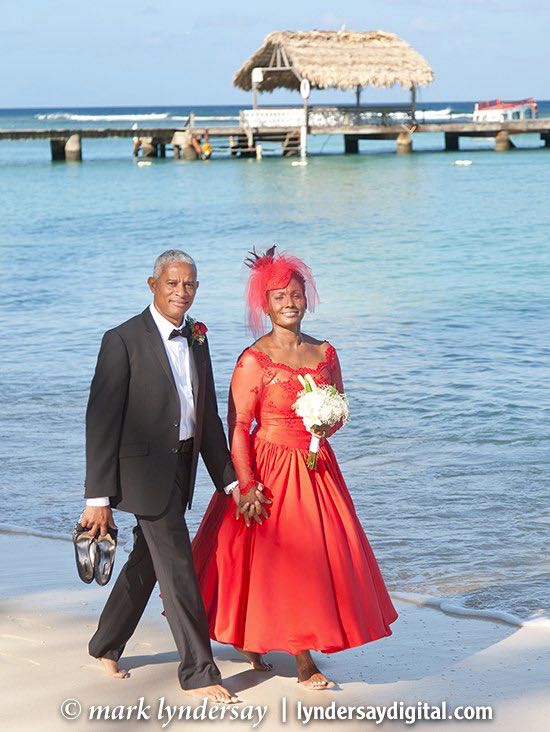
Alva Viarruel, Guardian Photo Editor, tied the knot on Easter Sunday morning with Reuters photographer Andrea De Silva, herself a former chief photographer of the paper. The wedding ceremony took place on the pier at Tobago's Pigeon Point Heritage Park. This photograph, a request by the bride, appeared on the front page of the Sunday Guardian for April 07, 2013.
Photograph by Mark Lyndersay.
On March 31, at seven in the morning, photographers Andrea De Silva and Alva Viarruel married on the dock at the Pigeon Point Heritage Park in Tobago.
I was there, invited by the two young image-makers to speak on their behalf at the reception to be held afterward and while we were milling around after the marriage ceremony and photographs were being taken by Elmo Griffith and Keeara Gopee, among others, Andrea pointed to the nearby sun dappled beach and said, “Hey Mark, let’s do some photos walking along the beach there.”
So that would be the second task I was called on to perform for the young couple that weekend.
This little talk, on behalf of both bride and groom to the assembled guests, was the first...
This is a story about two people who found each other.
It's a story about love.
But it's also a story about photography.
I met Andrea first, more than 20 years ago. She was the young hot thing in the Guardian photo department a young freelancer, vivacious, absurdly attractive with a megawatt smile that floored anyone she trained it on.
I’d meet Alva just a bit later on. He had been a lab assistant at the Guardian who had begun taking photographs of increasing sophistication. I remember a remarkable photo of an urban cyclist with a really good caption and telling him to shoot more like that and to write longer captions. I ended up giving him copies of US magazine, which I’d been reading as a guideline for the kind of little stories he could work up from his photographs. He ran with that, becoming a full-fledged crime reporter who sometimes took photographs before returning to the Guardian almost two years ago to become the Photo Editor of the paper.
These were two young people with ambition and talent. I was fortunate to touch their lives so many years ago. I hope I made a difference in their lives.
I've got many Andrea stories, but a wedding is the bride's day, so I'll save those for blackmail.
But I will tell you an Alva story.
Around 15 years ago, I met up with Alva on Carnival Monday after J’Ouvert on Duke Street, coming back from the festivities at Picadilly and Charlotte Streets. We both heard a sharp pop and then Alva flinched and held his hand. Blood was running from it and it wouldn’t stop. A truck might have rolled over a bottle and a shard probably cut his hand. It was clear that he needed medical attention, so I took his bag and putting pressure on the wound, we walked up the street to the Port of Spain hospital.
There at the Casualty Ward, we were witness to all the madness that reigns on a Carnival morning. The DJ who was stabbed for playing music the crowd didn’t like, a raving, screaming man wheeled by at high speed on a gurney by interns. Eventually a doctor came along and stitched Alva’s cut. We walked down the street, the brilliant sunshine and thinning crowds almost a relief after the concentrated mania of that morning’s experience. We parted company at the top of Charlotte street, heading off in different directions;
There isn't a big moral to this story. We looked out for each other as colleagues and I know that Alva and Andrea have done the same and more for each other.
Now these two photographers, these two friends, have chosen to bind their lives together. In their life's calling they have much in common. That's a blessing, but it can also be a curse. It's something you will need to manage.
It's at this point that I'm supposed to offer sage, experienced advice.
After 13 challenging, wonderful years with my wife Donna, I can confidently offer the following hard won advice.
Andrea. Sometimes Alva will be right. Really. Celebrate, acknowledge and yes, respect those occasions as they will - as all married men know quite clearly - come along very rarely.
Alva. This is absolutely true. It takes practice, but the correct answer to every question your wife asks from this day forth is "Yes dear, that will be fine."
And do us all a favour. Keep this beautiful woman smiling. It's how we've shared the joy of your lives together these past few years.
You will, from time to time, correct each other. Remember to do so as equals. You are two adults who have chosen each other's company, remember that when you disagree and your worst arguments will be at least productive. I can't guarantee cordial, not with two headstrong people like you two.
You've got a good thing going on here. Keep faith with each other, love each other strong and always remember what brought you together today, because it will keep you together for the rest of your lives.
Comments
Copyright discussion on TV6
19/02/13 19:56 Filed in: Video
Related…
BitDepth#875: CarnivalTV, 2013
BitDepth#874: Copyright and Cacada
BitDepth#873: Dear Allison
BitDepth#872: Tradition and Commerce
Photoblog: Carnival's Axis of Copyright
Photoblog: The Images of Carnival (Video)
Images of Carnival
06/02/13 20:22 Filed in: Video
Part one of the broadcast...
And here's part two...
Related…
BitDepth#875: CarnivalTV, 2013
BitDepth#874: Copyright and Cacada
BitDepth#873: Dear Allison
BitDepth#872: Tradition and Commerce
Photoblog: Carnival's Axis of Copyright
Photoblog: Morning Edition on Carnival copyright (Video)
TV6 - Images of Carnival, Part one from Mark Lyndersay on Vimeo.
And here's part two...
TV6 - Images of Carnival, Part Two from Mark Lyndersay on Vimeo.
Related…
BitDepth#875: CarnivalTV, 2013
BitDepth#874: Copyright and Cacada
BitDepth#873: Dear Allison
BitDepth#872: Tradition and Commerce
Photoblog: Carnival's Axis of Copyright
Photoblog: Morning Edition on Carnival copyright (Video)
Carnival's Axis of copyright
04/02/13 20:40 Filed in: Opinion
I’ve been advised, by a source with no reason to lie about such things, that some quite draconian fees have been instituted for the coverage of Carnival in 2013.
These fees break out as follows in T&T cash money as the unsuited thugs say…
NCC Fees: Personal use - $600.00, Commercial use - $800.00
Additional National Carnival Bandleader’s Association (NCBA) fees for coverage of costumed bands and individuals: personal use - $5,900.00, commercial use - $10,000.00 (permits two years of local usage). For international commercial usage for U.K. and Europe add $3,500.00. for international commercial usage for the US, add $3,000.00.
It’s unclear what rights “commercial usage” covers. That’s very specific terminology in photographic licensing and these terms would, if the NCBA understands what they are talking about here, allow a photographer to cover Carnival and sell it to, say, Prada for an advertising campaign in the US and Europe.
If that’s the case, $16,500 is a steal of a deal.
I suspect, however, that this isn’t what this Axis of Copyright has in mind.The NCC/NCBA/TUCO/Pan Trinbago coalition of shortsightedness has tended to see “commercial usage” as magazines offered for sale and prints sold in a photographic outlet, neither of which is particularly commercial or profitable and those fees applied to magazines could stand some testing in court.
The absurdity of charging for the documentation of a national festival isn’t something that photographers have been railing out only recently. In this interview with Noel Norton, he laments the fees charged more than 20 years ago which he paid every year in order to continue his work recording the national festival.
I witnessed begging expeditions by these same Carnival stakeholders to Norton’s studio to get access to images for one project or another, requests that the normally stern Mary Norton would always try to accommodate. Both of the Nortons photographed Carnival because they really loved this country and wanted to do their part to participate in its development.
In 2005, when they really began to struggle with the yearly trek to the Savannah, I wrote this letter to the NCC. A good friend of mine was present when it was read to the leadership of the NCC and it earned a single response: “What did Noel Norton ever do for Carnival?”
Not a single person spoke up for his years of service and the access they had offered to their archives. If anyone has ever wondered why I have been so biliously venal in my contempt for the NCC and everything it stands for, this is one outstanding reason why.
Now Carnival's Axis of copyright seems to want to limit or at the very least, severely tax the recording of Trinidad and Tobago’s Carnival. This is such a stunningly myopic notion that I cannot speak to it at all, instead I’ll just let Andrea De Silva explain why.
I’m very tempted to walk away from this mountain of crap. But here’s the truth. Carnival is bigger and more important than the stupidity of the people who are appointed to run it. There will come a day when we look back on these decisions and lament the chilling effect they had on serious coverage and documentation, but that won’t bring those lost events and personalities back.
Hundreds of hours of Carnival coverage have been either lost or are steadily deteriorating in what remains of TTT’s video archives. This year’s Panorama Semi-Finals went unrecorded while negotiations over rights dithered on. The Norton Archive of Carnival, captured through love and preserved with dedication, remains our most complete record of the last fifty years of Carnival and it is now, justifiably, the inheritance of Mary and Noel’s family.
Instead of acknowledging that there is a small but important tradition of documenting Carnival in this country and finding ways to seek mutual reward in the recording for posterity and future leverage of our country’s creative patrimony, the Axis of copyright has chosen taxation as its only tactic of negotiation and discussion.
Pay us or go away, they say to us. They don’t see what commercialising Carnival coverage has done to this country’s understanding of the festival. How decades of jam and wine photos have redefined the event using its most common and vulgar visual language.
Art doesn’t sell like hotcakes, but hotties do, so instead of a Carnival of creativity, documented and analysed, we get page after page of abs and boobs draped in feathers and spattered with glitter.
If Carnival is a golden goose, being paraded for the pleasure of the punters, this Axis of copyright is four fat fingers that are pressing steadily into its throat.
This year, they’re squeezing in for the big choke-off, I think.
Related…
BitDepth#875: CarnivalTV, 2013
BitDepth#874: Copyright and Cacada
BitDepth#873: Dear Allison
BitDepth#872: Tradition and Commerce
Photoblog: The Images of Carnival (Video)
Photoblog: Morning Edition on Carnival copyright (Video)
These fees break out as follows in T&T cash money as the unsuited thugs say…
NCC Fees: Personal use - $600.00, Commercial use - $800.00
Additional National Carnival Bandleader’s Association (NCBA) fees for coverage of costumed bands and individuals: personal use - $5,900.00, commercial use - $10,000.00 (permits two years of local usage). For international commercial usage for U.K. and Europe add $3,500.00. for international commercial usage for the US, add $3,000.00.
It’s unclear what rights “commercial usage” covers. That’s very specific terminology in photographic licensing and these terms would, if the NCBA understands what they are talking about here, allow a photographer to cover Carnival and sell it to, say, Prada for an advertising campaign in the US and Europe.
If that’s the case, $16,500 is a steal of a deal.
I suspect, however, that this isn’t what this Axis of Copyright has in mind.The NCC/NCBA/TUCO/Pan Trinbago coalition of shortsightedness has tended to see “commercial usage” as magazines offered for sale and prints sold in a photographic outlet, neither of which is particularly commercial or profitable and those fees applied to magazines could stand some testing in court.
The absurdity of charging for the documentation of a national festival isn’t something that photographers have been railing out only recently. In this interview with Noel Norton, he laments the fees charged more than 20 years ago which he paid every year in order to continue his work recording the national festival.
I witnessed begging expeditions by these same Carnival stakeholders to Norton’s studio to get access to images for one project or another, requests that the normally stern Mary Norton would always try to accommodate. Both of the Nortons photographed Carnival because they really loved this country and wanted to do their part to participate in its development.
In 2005, when they really began to struggle with the yearly trek to the Savannah, I wrote this letter to the NCC. A good friend of mine was present when it was read to the leadership of the NCC and it earned a single response: “What did Noel Norton ever do for Carnival?”
Not a single person spoke up for his years of service and the access they had offered to their archives. If anyone has ever wondered why I have been so biliously venal in my contempt for the NCC and everything it stands for, this is one outstanding reason why.
Now Carnival's Axis of copyright seems to want to limit or at the very least, severely tax the recording of Trinidad and Tobago’s Carnival. This is such a stunningly myopic notion that I cannot speak to it at all, instead I’ll just let Andrea De Silva explain why.
I’m very tempted to walk away from this mountain of crap. But here’s the truth. Carnival is bigger and more important than the stupidity of the people who are appointed to run it. There will come a day when we look back on these decisions and lament the chilling effect they had on serious coverage and documentation, but that won’t bring those lost events and personalities back.
Hundreds of hours of Carnival coverage have been either lost or are steadily deteriorating in what remains of TTT’s video archives. This year’s Panorama Semi-Finals went unrecorded while negotiations over rights dithered on. The Norton Archive of Carnival, captured through love and preserved with dedication, remains our most complete record of the last fifty years of Carnival and it is now, justifiably, the inheritance of Mary and Noel’s family.
Instead of acknowledging that there is a small but important tradition of documenting Carnival in this country and finding ways to seek mutual reward in the recording for posterity and future leverage of our country’s creative patrimony, the Axis of copyright has chosen taxation as its only tactic of negotiation and discussion.
Pay us or go away, they say to us. They don’t see what commercialising Carnival coverage has done to this country’s understanding of the festival. How decades of jam and wine photos have redefined the event using its most common and vulgar visual language.
Art doesn’t sell like hotcakes, but hotties do, so instead of a Carnival of creativity, documented and analysed, we get page after page of abs and boobs draped in feathers and spattered with glitter.
If Carnival is a golden goose, being paraded for the pleasure of the punters, this Axis of copyright is four fat fingers that are pressing steadily into its throat.
This year, they’re squeezing in for the big choke-off, I think.
Related…
BitDepth#875: CarnivalTV, 2013
BitDepth#874: Copyright and Cacada
BitDepth#873: Dear Allison
BitDepth#872: Tradition and Commerce
Photoblog: The Images of Carnival (Video)
Photoblog: Morning Edition on Carnival copyright (Video)
Noel and Mary Norton on Trinidad's Carnival
04/02/13 20:32 Filed in: Interview
This interview with Noel and Mary Norton appeared in the book Noel Norton’s 20 Years of Trinidad Carnival , published in 1990 and currently out of print. Given the travails of modern Carnival, it is reproduced here as a reference point for how little has changed since then. Read More...
The Andros Factor
14/01/13 22:48 Filed in: Opinion
Andros Belfonte and I have very different views about what constitutes a career in photography. This post and the comments and Facebook threads that are linked to it offer some insight into what we both think about the way photography should be done today. Read More...
Andros chat
14/01/13 22:47 Filed in: Transcript
If you're not on Facebook, the transcript of the posts that sparked a discussion about the practice of modern professional photography is here. Read More...
On local photography, a 2012 overview
31/12/12 20:56 Filed in: Review
Photography's resurgence
An overview of the surge in photographic activity during 2012, originally published in the Sunday Guardian for December 30, 2012.

Coolie Girl, The Jocelyn Arnott Collection, courtesy Paria Publishing.
In 2012, photography seemed to be moving from the sidelines to centre stage in the art world, or at the very least, onto walls normally reserved for the admiration of paintings and sketches.
With no less than three major showings this year and three accompanying documents coming out of those projects, the craft of photography became a subject of conversation and reevaluation in the arts space.
The three shows, Pictures in Paradise, a gallery talk and running slideshow in support of a hefty regional overview of contemporary photography, the Art Society's Record : Art : Memory, an Independence anniversary inspired overview of the craft as public archive and 10, Alex Smailes'retrospective of his work in Trinidad and Tobago, each brought different perspectives to the contemplation of what photography means in 2012.
The work on the walls of Smailes'exhibition, large prints held to the spare white walls at Medulla by tiny magnets articulated the photographer's ethos of no fuss accessibility to the work. The photographer eschewed a formal book in favour of large sheets of images printed by the Guardian on high brite newspaper and bundled informally into a brown cardboard box with identifying information silkscreened into it.
Funeral of Billy Danglade aged 13 Morvant Trinidad 2005, photograph by Alex Smailes
Emphasising low cost accessibility for the work, Smailes priced the work affordably both on the walls and collected in the casual "box set."
Smailes'approach to photography is useful to note, because he's the only photographer whose work is represented in all three shows and documents.
British trained and war-zone honed, Alex Smailes came to this country at the turn of the century to work on a book project that he hoped would explain this part of his bloodline, first for himself and then for his readers.
Over the course of that decade he evolved his attentions from the issues of the region to those of hard knock families living within just a few blocks of his office at Fernandes Compound.
At his artist's talk at the end of his show, Smailes traced the route he took since coming to this country and choosing to settle here, closing the talk with new digital images that sparkled with the hip, colourful gloss of modern visual branding and eye candy seduction.
The work is at a striking remove from the grit and ruthless honesty of his journalism, those images reeking of a disturbing reality. The newer images, for which he is no doubt much better paid, offered an invented truth constructed out of Caribbean flavoured elements with which he had become intimately familiar.
Has Trinidad and Tobago been good to Smailes and his work?
Is it good to photography at all?
These three shows all strove mightily to address the latter question, positing visual theses to support varying roles and value that might be assigned to this business of taking photographs.
It's a useful question to be considering at this time in the craft's development in this country.
Photographers in Trinidad and Tobago, in numbers never before seen in what was once a small market, are struggling with the constantly changing expectations of image making, the massive consumption of images through the firehose of often dubious Facebook postings and a vigorous newbie enthusiasm to become the next big thing.
Two decades ago when I served on the Art Society's board, Carlisle Chang, never an artist to mince words, allowed my presence as a representative of the plastic arts. If he were witness to today's explosion of software driven artifice and gimmickry, he might be prone to dismiss the whole cycle of undisciplined exploration as a spastic art, I'm sure.
Local photography finds itself in a curious place now, accorded the respect of exhibition and ennobled by the success of these three projects, it finds itself elbowed onto a table of more rarefied considerations.
This is quite an accomplishment, having skipped the torturous debates and demanding reconsiderations and deconstructions that accompanied such artistic upgrades in the first world.
The respect accorded to photography as a visual art in Trinidad and Tobago has received a welcome boost from that international acceptance of the craft as occasional but not necessarily automatic art, but the architecture that supports such an elevation is almost entirely missing.
In that absence, Melanie Archer, a designer with strong curatorial credits and Marsha Pearce, a doctoral candidate with a modernist view of creative arts, have emerged as coordinators and explicators of this new shift, bolting together a superstructure beneath this rapid ascension of photography almost as quickly as it soars.
Both Archer and Pearce have either been involved with, present for or consulted on the production of all three exhibitions and their role in making this new appreciation of photography as art sustainable is not to be underestimated.
Which doesn't mean that there are no issues. Photography is, for the most part, a straightforward craft, made even simpler by modern cameras and technologies which almost completely remove the need to think about fussy things like exposure and focusing in today's picture taking.
Kodak may have had to advertise that it would do "the rest" for hopeful photographers a century ago, but today's camera owners simply accept that the magic box in their hands, whether it be an iPhone or a high-end digital SLR, knows more about the details of picture taking than they do.
Such smart processors and programming have made it possible for almost anyone to take a good picture, but they have increased the gap between good and great quite dramatically.
Into that canyon have been poured filters, Photoshop actions, enhanced dynamic range imaging and dramatic transformations that seek to lift image making beyond the cleverness of cameras, but so many of these effects, best summarised by the popular Instagram, substitute style for considered thought and effect for creative authority.
Photography that aspires to lasting value, let alone art cannot simply be good anymore, it must inform, infer and engage on a quite different level.
That was the message of the Art Society's Record : Art : Memory (henceforth AS:RAM) which turned out to be a culling of the best of what's left, a curatorial exercise undertaken by Abigail Hadeed, whose search for photographs taken over the last half century was as much a funeral for lost works as it was a joyful celebration of the important works celebrated at the society's Federation Park headquarters.
Even among the works that were featured, some were offered anonymously, their authorship long ground up in the laissez faire bureaucracy of newspaper filing systems (more on that here: http://ow.ly/gbcCv), others the result of an accident of wealth, expertise and curiosity that led to privileged eyes using expensive cameras and film to record ordinary, attractively quaint lifestyles.
These photographs draw their power and capacity to move by bringing the ruthlessly faithful record of film forward by a more than half a century to eyes that have never beheld such sights.
That capacity to record and the malleability of today's photographic works bring two branches of photographic approach into inevitable conflict and nowhere was that clearer than in Pictures from Paradise, billed as "A survey of contemporary Caribbean photography," by its producer, Robert and Christopher Publishers.
Between the covers of the 200 plus page book, co-edited by Mariel Brown and Melanie Archer is a wide ranging collection of work from Caribbean photographers that cleaves cleanly between artifice and documentation.
Pictures from Paradise offers a collection of works that are striking in their often quite divergent motivations, offering the dramatically spare works of Abigail Hadeed, Radcilffe Roye and Gerard Gaskin, the faux documentary works of Renee Cox and the artist as photographer explorations of James Cooper, Holly Bynoe and Marvin Bartley.
It's quite beyond the scope of this contemplation to delve deeper into the wealth of work offered up by Paradise, but the book quite clearly explicates the challenges that tomorrow's photographers will face in finding an effective way of expressing themselves.
Is photography art, then? A more compelling question might be whether it needs to be. Much of what's called art is so described because it's paint on a canvas, but that doesn't stop it from also being uninspired hackwork, attractive, market focused daubings that match household decors but stir no souls.
At its best, photography is photographic, whether it's built out of film grain or pixels. There's a direct line of visual connection between the delicate beauty and ornate details of the Indian betis in the Jocelyn Arnott collection at AS:RAM and the hyperreal Hasselblad digital composites of Marvin Bartley.
Both works are as determinedly photographic as they are different in execution, but both champion photography itself as a goal worthy of pursuit, with the determinations of art left to other forces and agendas.
An overview of the surge in photographic activity during 2012, originally published in the Sunday Guardian for December 30, 2012.

Coolie Girl, The Jocelyn Arnott Collection, courtesy Paria Publishing.
In 2012, photography seemed to be moving from the sidelines to centre stage in the art world, or at the very least, onto walls normally reserved for the admiration of paintings and sketches.
With no less than three major showings this year and three accompanying documents coming out of those projects, the craft of photography became a subject of conversation and reevaluation in the arts space.
The three shows, Pictures in Paradise, a gallery talk and running slideshow in support of a hefty regional overview of contemporary photography, the Art Society's Record : Art : Memory, an Independence anniversary inspired overview of the craft as public archive and 10, Alex Smailes'retrospective of his work in Trinidad and Tobago, each brought different perspectives to the contemplation of what photography means in 2012.
The work on the walls of Smailes'exhibition, large prints held to the spare white walls at Medulla by tiny magnets articulated the photographer's ethos of no fuss accessibility to the work. The photographer eschewed a formal book in favour of large sheets of images printed by the Guardian on high brite newspaper and bundled informally into a brown cardboard box with identifying information silkscreened into it.

Emphasising low cost accessibility for the work, Smailes priced the work affordably both on the walls and collected in the casual "box set."
Smailes'approach to photography is useful to note, because he's the only photographer whose work is represented in all three shows and documents.
British trained and war-zone honed, Alex Smailes came to this country at the turn of the century to work on a book project that he hoped would explain this part of his bloodline, first for himself and then for his readers.
Over the course of that decade he evolved his attentions from the issues of the region to those of hard knock families living within just a few blocks of his office at Fernandes Compound.
At his artist's talk at the end of his show, Smailes traced the route he took since coming to this country and choosing to settle here, closing the talk with new digital images that sparkled with the hip, colourful gloss of modern visual branding and eye candy seduction.
The work is at a striking remove from the grit and ruthless honesty of his journalism, those images reeking of a disturbing reality. The newer images, for which he is no doubt much better paid, offered an invented truth constructed out of Caribbean flavoured elements with which he had become intimately familiar.
Has Trinidad and Tobago been good to Smailes and his work?
Is it good to photography at all?
These three shows all strove mightily to address the latter question, positing visual theses to support varying roles and value that might be assigned to this business of taking photographs.
It's a useful question to be considering at this time in the craft's development in this country.
Photographers in Trinidad and Tobago, in numbers never before seen in what was once a small market, are struggling with the constantly changing expectations of image making, the massive consumption of images through the firehose of often dubious Facebook postings and a vigorous newbie enthusiasm to become the next big thing.
Two decades ago when I served on the Art Society's board, Carlisle Chang, never an artist to mince words, allowed my presence as a representative of the plastic arts. If he were witness to today's explosion of software driven artifice and gimmickry, he might be prone to dismiss the whole cycle of undisciplined exploration as a spastic art, I'm sure.
Local photography finds itself in a curious place now, accorded the respect of exhibition and ennobled by the success of these three projects, it finds itself elbowed onto a table of more rarefied considerations.
This is quite an accomplishment, having skipped the torturous debates and demanding reconsiderations and deconstructions that accompanied such artistic upgrades in the first world.
The respect accorded to photography as a visual art in Trinidad and Tobago has received a welcome boost from that international acceptance of the craft as occasional but not necessarily automatic art, but the architecture that supports such an elevation is almost entirely missing.
In that absence, Melanie Archer, a designer with strong curatorial credits and Marsha Pearce, a doctoral candidate with a modernist view of creative arts, have emerged as coordinators and explicators of this new shift, bolting together a superstructure beneath this rapid ascension of photography almost as quickly as it soars.
Both Archer and Pearce have either been involved with, present for or consulted on the production of all three exhibitions and their role in making this new appreciation of photography as art sustainable is not to be underestimated.
Which doesn't mean that there are no issues. Photography is, for the most part, a straightforward craft, made even simpler by modern cameras and technologies which almost completely remove the need to think about fussy things like exposure and focusing in today's picture taking.
Kodak may have had to advertise that it would do "the rest" for hopeful photographers a century ago, but today's camera owners simply accept that the magic box in their hands, whether it be an iPhone or a high-end digital SLR, knows more about the details of picture taking than they do.
Such smart processors and programming have made it possible for almost anyone to take a good picture, but they have increased the gap between good and great quite dramatically.
Into that canyon have been poured filters, Photoshop actions, enhanced dynamic range imaging and dramatic transformations that seek to lift image making beyond the cleverness of cameras, but so many of these effects, best summarised by the popular Instagram, substitute style for considered thought and effect for creative authority.
Photography that aspires to lasting value, let alone art cannot simply be good anymore, it must inform, infer and engage on a quite different level.
That was the message of the Art Society's Record : Art : Memory (henceforth AS:RAM) which turned out to be a culling of the best of what's left, a curatorial exercise undertaken by Abigail Hadeed, whose search for photographs taken over the last half century was as much a funeral for lost works as it was a joyful celebration of the important works celebrated at the society's Federation Park headquarters.
Even among the works that were featured, some were offered anonymously, their authorship long ground up in the laissez faire bureaucracy of newspaper filing systems (more on that here: http://ow.ly/gbcCv), others the result of an accident of wealth, expertise and curiosity that led to privileged eyes using expensive cameras and film to record ordinary, attractively quaint lifestyles.
These photographs draw their power and capacity to move by bringing the ruthlessly faithful record of film forward by a more than half a century to eyes that have never beheld such sights.
That capacity to record and the malleability of today's photographic works bring two branches of photographic approach into inevitable conflict and nowhere was that clearer than in Pictures from Paradise, billed as "A survey of contemporary Caribbean photography," by its producer, Robert and Christopher Publishers.
Between the covers of the 200 plus page book, co-edited by Mariel Brown and Melanie Archer is a wide ranging collection of work from Caribbean photographers that cleaves cleanly between artifice and documentation.
Pictures from Paradise offers a collection of works that are striking in their often quite divergent motivations, offering the dramatically spare works of Abigail Hadeed, Radcilffe Roye and Gerard Gaskin, the faux documentary works of Renee Cox and the artist as photographer explorations of James Cooper, Holly Bynoe and Marvin Bartley.
It's quite beyond the scope of this contemplation to delve deeper into the wealth of work offered up by Paradise, but the book quite clearly explicates the challenges that tomorrow's photographers will face in finding an effective way of expressing themselves.
Is photography art, then? A more compelling question might be whether it needs to be. Much of what's called art is so described because it's paint on a canvas, but that doesn't stop it from also being uninspired hackwork, attractive, market focused daubings that match household decors but stir no souls.
At its best, photography is photographic, whether it's built out of film grain or pixels. There's a direct line of visual connection between the delicate beauty and ornate details of the Indian betis in the Jocelyn Arnott collection at AS:RAM and the hyperreal Hasselblad digital composites of Marvin Bartley.
Both works are as determinedly photographic as they are different in execution, but both champion photography itself as a goal worthy of pursuit, with the determinations of art left to other forces and agendas.
The Queen
18/12/12 00:47 Filed in: Technique

Athaliah Samuel, photographed on December 15, 2012.
I've had an opportunity to photograph a beauty queen or two, beginning my career with a photograph of Janelle "Penny" Commissiong and doing a photo or two of Giselle La Ronde-West and Wendy Fitzwilliam.
The high-stakes fashion and beauty world isn't something I've spent too much time considering professionally generally and no time at all contemplating since returning to full-time photography seven years ago.
There are far too many enthusiastic photographers running around and way too many keen young women posing for them for that whole scene to look like anything other than bees in a particularly sweet flowering field. I leave the pollination allusions up to you.
A few months ago, though, I stepped into some particularly noxious discussions on Facebook about Athaliah Samuel, this country's 2012 Miss World candidate.
Triggering this discussion were some particularly awful photographs of the young woman which I saw as an indictment of the photographer's skill and judgement, not the model's.
Many people don't realize the power that a photographer has over a photography session and how pliable a young model can be when the person behind the camera exercises that authority.
Add inexperience into the mix and truly awful things can result.
Athaliah had trusted her photographer, her makeup artist and her stylist on that shoot and they had all failed her terribly. While I was railing about all this, Damian Luk Pat stepped up to the challenge and provided the young model with photographs that were more in keeping with her role and her beauty.
Imagine my surprise then to realize that Athaliah had been in touch with me via Facebook private message politely and quite flatteringly asking for a photo session.
As with all such requests, I'd deferred the opportunity, suggesting that other young photographers might be keen to photograph her. By now I was basically appalled that I'd had a hand in throwing the young woman to the photographic wolves and vowed to make good at the first opportunity.
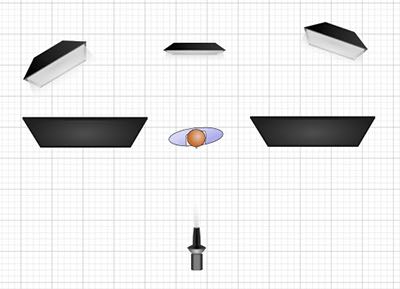
That chance came along this weekend when I needed someone to be photographed for a lighting talk and demonstration. Multiple birds were lined up to be brained with a single artful throw on this one.
Athaliah proved to be everything I'd expected from her interviews and responses to the many cruel comments that had been made about her.
This is a young woman who has had no silver spoon opportunities who intends to upgrade her life's cutlery and is doing so with energy, enthusiasm and a remarkably positive outlook. I was mightily impressed by her and I hope the photographs we did nudge her along on her life's journey.
Photography as a vocation
26/11/12 23:19 Filed in: Opinion
Why do we photograph? It's not a question that seems to come up very often, but it's one that's worth asking ourselves constantly.
Some thoughts about my own motivations and considerations on the matter are here... Read More...
Asked, answered
19/11/12 23:45 Filed in: Business
Two young photographers put some interesting questions to me. With their permission, I answer publicly in the hope that the responses might be of use to some one else. Read More...
The Photographer's Responsibility
01/10/12 21:22 Filed in: Business
Taking care of your photographic works and leveraging those assets isn't your client's responsibility, it's part of a professional's charge and compact with customers who are supposed to know less than we do about photography's nuances. Read More...
On shooting for free
09/07/12 22:15 Filed in: Business
Should we take pictures for free? Should we charge for every picture we take? Here are my experiences with deciding when to charge and when a fee is inadequate payment for a photographic experience. Read More...
The TNT Mirror's resource reallocations
16/04/12 20:45 Filed in: Business
You can find the original post and discussion on Facebook here. This facsimile of the post (I have resisted the temptation to correct spellings) and the ensuing thread, begun on March 30, 2012, is posted for the convenience of those who aren't on that social media service.
For the full, rather long thread click here to... Read More...
Laura Ferreira on Copyright
13/02/12 20:35 Filed in: Interview
The full text of my e-mail interview with Laura Ferreira about a recent copyright infringement incident. Read More...